
Geopolitical uncertainty makes circular production no longer a choice, but necessity

Geopolitical uncertainty makes circular production no longer a choice, but necessity

The past few years have shown how vulnerable linear supply chains can be. Conflicts, trade tension and disruptions to raw material flows are causing significant price fluctuations. For clients and contractors working in the public realm, this raises a pressing question: how can the procurement and management of infrastructure projects be organised in a way that is less dependent on the volatility of global markets?

At AGMI we see this as confirmation of something we have been focussing on for years: circular production as a structural response to a structural problem.

Aluminium, polymers and energy: three vulnerable links

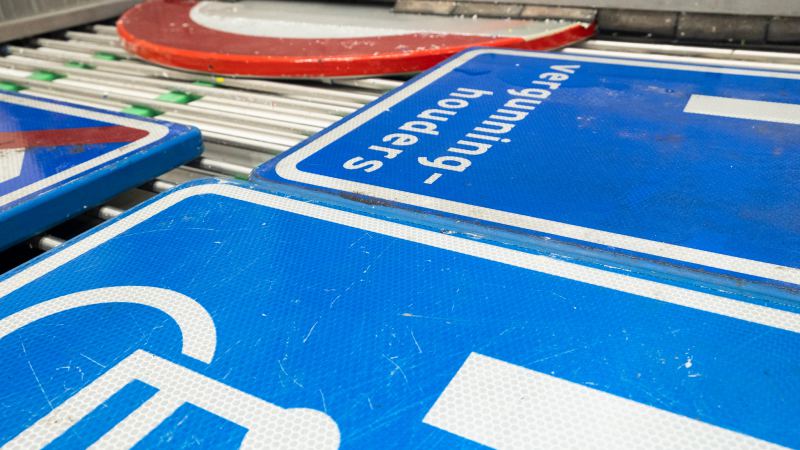
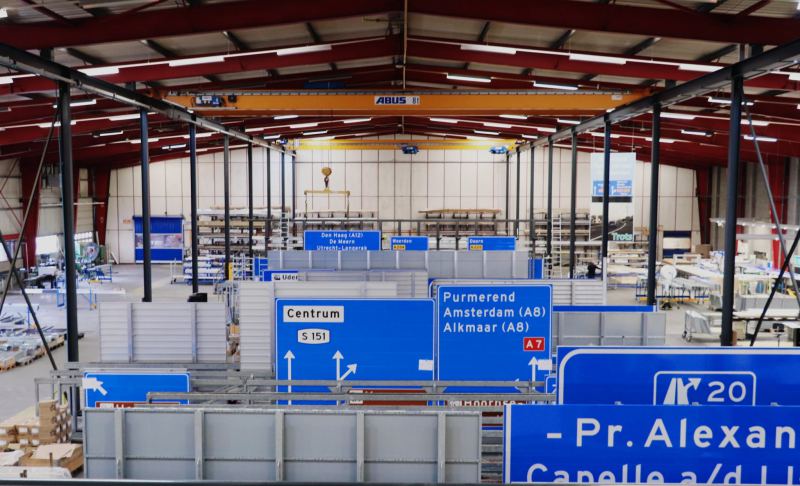
Virtually every traffic and directional sign produced by AGMI uses aluminium as its supporting material. Aluminium is lightweight, durable and easy to process, but it's production is highly sensitive to international tensions.

But aluminium is not the only raw material that comes under pressure. Every sign is fitted with retroreflective sheeting: a high-quality plastic film with microprisms that make traffic and directional signs visible in darkness and poor weather conditions. These films are made from polymers, wich are petrochemical products. Rising oil proces therefore have a direct impact on the cost of every new sign. The same applies to energy required to produce aluminium and process plastics: energy prices are also sensitive to geopolitical developments and international market conditions.

Aluminium retains its value, making it inherently circular

What distinguishes aluminium from many other materials is that it retains its quality after reuse. Aluminium can be remelted virtually indefenitely without its material properties deteriorating. Moreover, remelting existing aluminium requires only a fraction of the energy needed to extract it from bauxite ore. This makes aluminium not only environmentally interesting, but also economically valuable: its residual value remains high, regardless of how many use cycles a product has gone through.

With Re-Sign®, AGMI takes this a step further: the aluminium substrate does not need to be melted down at all. By simply removing the sheeting and reusing the substrate, the material remains completely intact. 

Invisible sustainability

A practical advantage of Re-Sign® is that the streetscape remains unchanged. the vast majority of traffic and directional signs currently used in the Netherlands are already made of aluminium. A refurbished sign looks identical to a new sign. Nothing changes visually, but behind the scenes, everything changes.


Circularity as risk management

The discussion around circularity is generally focused on CO₂ reduction and environmental targets. Rightly so. But the current geopolitical reality adds a dimension that may be even more tangible for clients and procurement departments: security of supply and cost control.

A circular product is one in wich the value of the raw material does not disappear after use, but remains within the supply chain. This is particularly true for aluminium. Re-Sign® makes this principle operational: it is not a promise, but an everyday process.

Municipalities, provinces, contractors and other road authorities that work with AGMI are therefore building infrastructure that is less sensitive to external shocks and shocks and aligns with sustainability objectives that are increasingly becoming part of tender criteria. 

How can we help you move forward?

Want to talk about this? 

Absolutely! Simply leave your details via the contact form and we would be happy to get in touch.