

Reflective sheeting on traffic signs is essential for visibility and road safety. However, not all reflective sheeting is the same. There are diferent performance classes: Class I, II and III, each offering different levels of retroreflectivity, durability and suitability for specific applications. In many applications in the Netherlands, Class III is specified or recommended, depending on the requirements of the road authority and the project. Do you know what sets these classes apart? And would you be able to recognise the different classes on a traffic sign? In this article, we''ll take a closer look.
The impact of reflective sheeting selection on visibility and road safety


Understanding the classes
The retroreflective performance of traffic signs is classified, among other things, according to NEN-EN 12899-1. commonly reffered to as RA1, RA2 and RA3. In the industry, these are also known as Class I, II and III, respectively.
- Class I / RA1 has the lowest retroreflectivity.
- Class II / RA2 offers a medium level of retroreflectivity.
- Class III / RA3 provides the highest level of retroreflectivity and is commonly used in the Netherlands, particularly where high levels of nighttime visibility are required, recommended or specified.
A higher class generally provides better retroreflective performance across a wider range of observation and entrance angles, which can improve nighttime visibility. However, the visibility of a traffic sign depends on more than just the sheeting class. Colour, sign size, positioning, observation angle, entrance angle, vehicle lighting, dirt, weather conditions and the age of the sign all play a role.
RA3A and RA3B: understanding the difference within the highest class
Within RA3/Class III, a distinction is made between RA3A and RA3B, two subtypes defined in the DIN 67520 standard for prismatic sheeting. Visibility is not simply a matter of whether you can or cannot see something near or far. The difference lies in the details, in this case thousands of microscopic prism structures per square centimetre. The shape of the light cone reflected by the sheeting also determines whether a sign is clearly visible at a specific angle and distance. This is where RA3A and RA3B differ significantly.
Both subtypes belong to the highest retrofelective class under the European classification system, but they do not have exactly the same performance profile. The difference lies in their retroreflective performance at specified combinations of observation and entrance angles. As a result, one RA3 variant may perform better than the other in a particular traffic situation, depending on factors such as viewing distance, mounting angle, sign position, headlight height, direction of travel, speed and road geometry.
RA3A and RA3B shoudl therefore not simply be regarded as 'good' and 'better', but as two high-performance variants with different characteristics that can complement each other effectively in practice.
In the Netherlands, RA3A cannot be used as a standalone class; only RA3B is permitted as a standalone class. By combining RA3A en RA3B, traffic signs can be made visible across a wider range of distances and positions alongside and above the road, helping to ensure visibility for all road users.
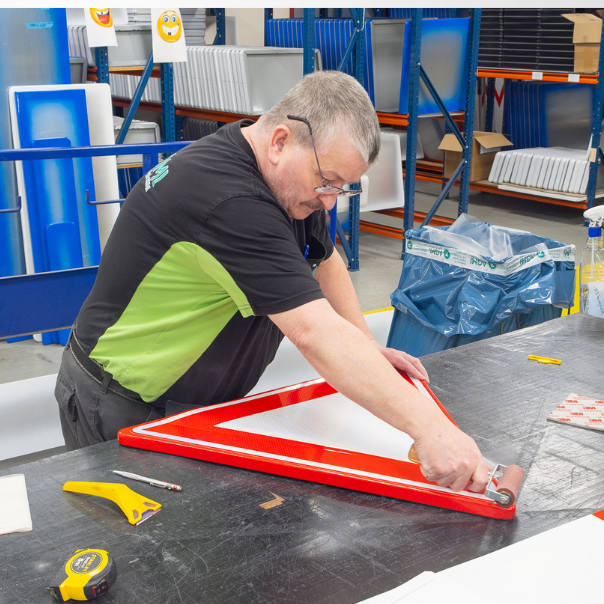
Differences in visibilty
The differences between the classes are most noticable at night. With a lower class (I/RA1), a sign generally becomes clearly visible only at close range. With Class III/RA3, traffic signs can be seen from much greater distances, provided they are correctly selected, installed and maintained. This is essential for road safety, especially at high speeds or in poor weather conditions.
RA3A sheeting can also make signs clearly visible form even greater distances. When a sign can be read earlier, road users have more time to process the information and can keep their attention on the road more effictively, helping to improve road safety.
Service life
In addition to retroreflectivity, the service life of the sheeting also plays an important role. The higher the class, the longer the sheeting generally lasts. A longer service life generally means less maintenance and lower replacement costs in the long term.
Who determines which class is used
The choice of reflective sheeting is primarily determined by the road authority, such as a municipality. provincial authority or Rijkswaterstaat. Contractors, tender specifications, standards, guidelines and project requirements.
The NEN 3381 standard specifies a minimum of Class RA2 for most traffic signs governed by the Dutch Road Traffic Signs and Regulations (RVV), but recommends Class RA3, with at least RA3B performance.
We generally recommend Class III/RA3 sheeting that meets both RA3A and RA3B performance requirements. If there is a specific preference or budget constraint, we are happy to help determine the most suitable solution for each situation. Naturally, we always take safety guidelines, sustainability and cost efficiency into account.
Need advice? We're happy to help
Choosing the right reflective sheeting is essential for road safety. Traffic signs with better visibility directly contribute to safer raods and support every raod authority's goal of reducing the number of traffic accidents.
Would you like to know how we can help improve road safety for your project or specific situation? Our specialist will be happy to assist you.
Contact us for tailored advice.