

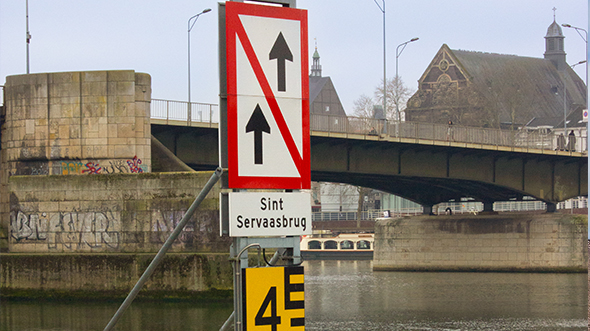
Maritime signs are essential tools for safety and navigation on inland waterways. They provide instructions, prohibitions, obligations, and information to skippers, similar to traffic signs on the road. These signs are designed according to specific guidelines to ensure uniformity and clarity.
Why maritime signs and their structures are crucial for shipping
Application of maritime signs
Maritime signs can be found in various locations, including ports, locks, bridges, river branches, mooring areas, narrow waterways, and fast-flowing waters. They serve to inform waterway users about speed limits, right-of-way situations, and navigation routes. Correct placement and maintenance of these signs is crucial for smooth and safe traffic flow on the waterways.
Legislation and regulations: Guidelines for maritime signs
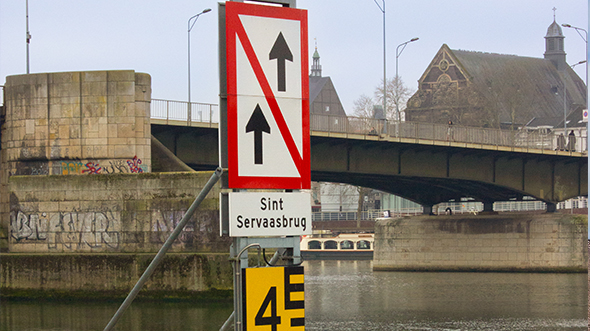
Maritime signs in the Netherlands must comply with the Scheepvaarttekens guidelines, established by Rijkswaterstaat. These guidelines ensure uniformity and clarity across all Dutch inland waterways and include:
-
Classification and meaning of maritime signs
The signs are divided into several categories:
- Mandatory signs (blue round signs with white pictograms) indicating obligations, such as “Sail here” or “Use VHF channel X.”
- Prohibition signs (red round signs with a black pictogram and red border), for example “No turning” or “No vessels longer than X meters.”
- Information signs (rectangular blue or white) providing additional information, such as “Mooring allowed” or “Berth for specific vessels.”
- Warning signs (triangular with red border) indicating hazards, such as “Strong current” or “Low bridge.”
-
Material and reflectivity requirements
All maritime signs must meet retroreflectivity class RA2 or RA3, ensuring good visibility under different weather conditions and at night. The dimensions vary depending on the location and the distance from which the sign must be visible.
-
Placement regulations
The height and distance of signs relative to the water surface are strictly regulated. For example, at locks, signs must be positioned at a minimum height of 2.5 meters above water level. At bridges and harbors, signs must be placed so they are clearly visible without obstructing skippers’ view of other traffic.
-
Mandatory signalling at locks and bridges
Bridges and locks require additional signage, such as red-green signal lights and supplementary signs to clearly indicate the passage status. Zoning signs should be used to clarify the separation between different types of waterway traffic.
-
Outdated or damaged signs
Signs that no longer meet the current guidelines must be replaced. With AGMI Re-Sign, AGMI offers a circular production technique to reuse existing traffic signs, contributing to sustainability and cost savings.

Need maritime signage?
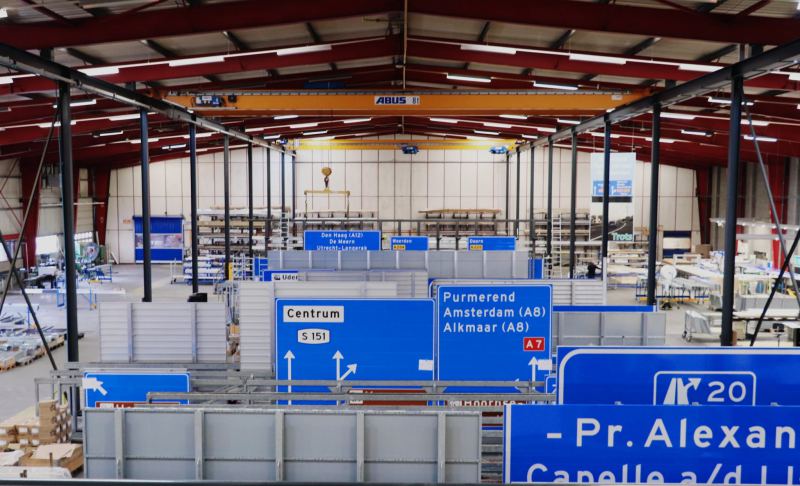
At AGMI Traffic & Lighting, we design and produce a comprehensive range of maritime signs that comply with the latest laws and regulations.
Order easily and quickly through our webshop
All of our maritime signs are available in our webshop and are designed with high-quality materials for long-lasting durability and optimal visibility. In addition, we offer supporting structures, providing a complete solution for the installation of your signs.
More than just maritime signs
Finally, we can also provide safety, escape route, and zoning signs for use at locks and other waterworks.
Need advice?
Are you responsible for the implementation or renovation of maritime signs? Would you like to know how AGMI Traffic & Lighting can help? Or do you need concrete advice for your signage project?
Get in touch with us today, or leave your details so we can contact you. Together, we’ll make your project a success!